

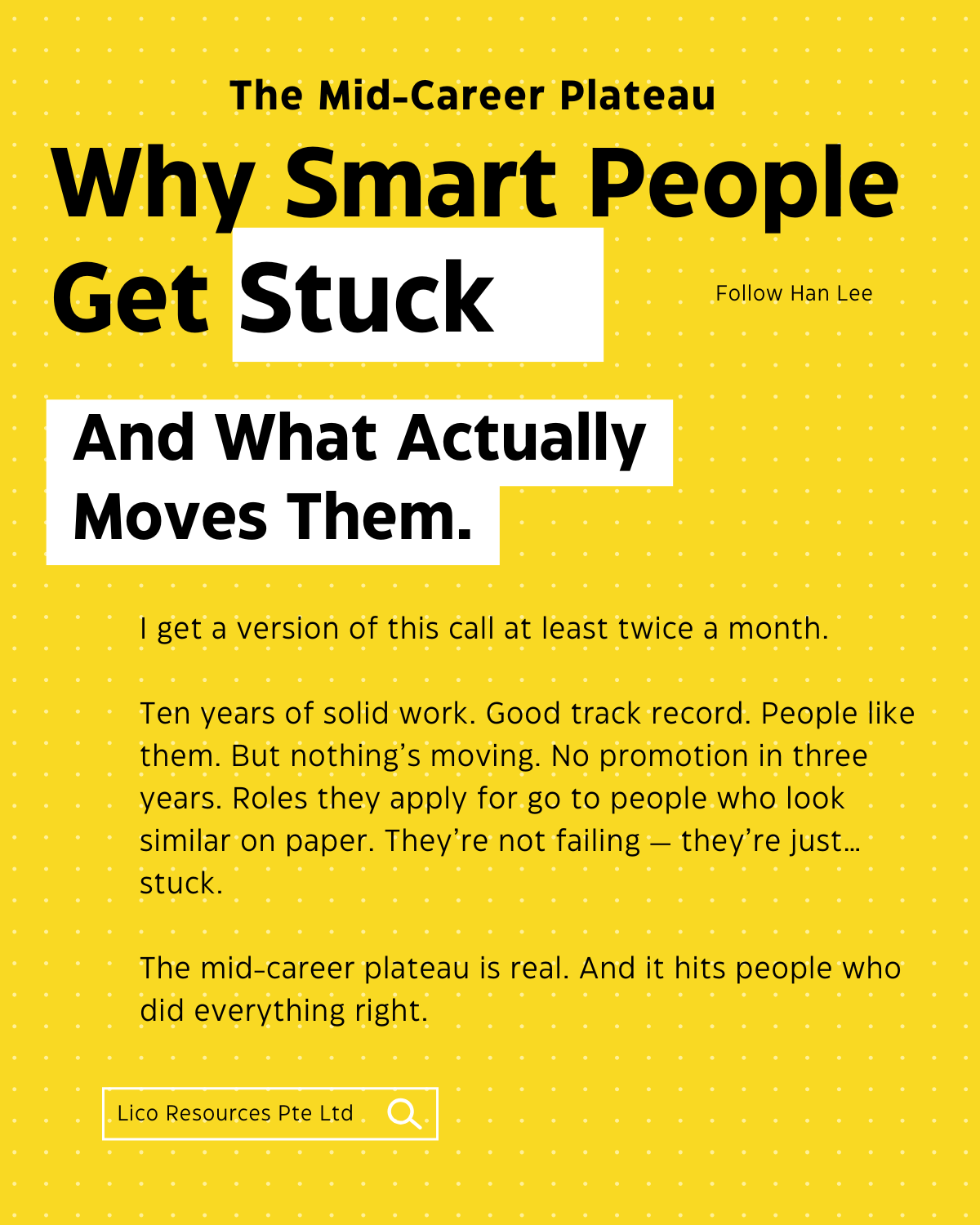
I get a version of this call at least twice a month. Ten years of solid work. Good track record. People like them. But nothing's moving. No promotion in three years. Roles they apply for go to people who look similar on paper. They're not failing — they're just… stuck.
The mid-career plateau is real. And it hits people who did everything right.
Here's what I've observed after placing people across this exact stage for years.
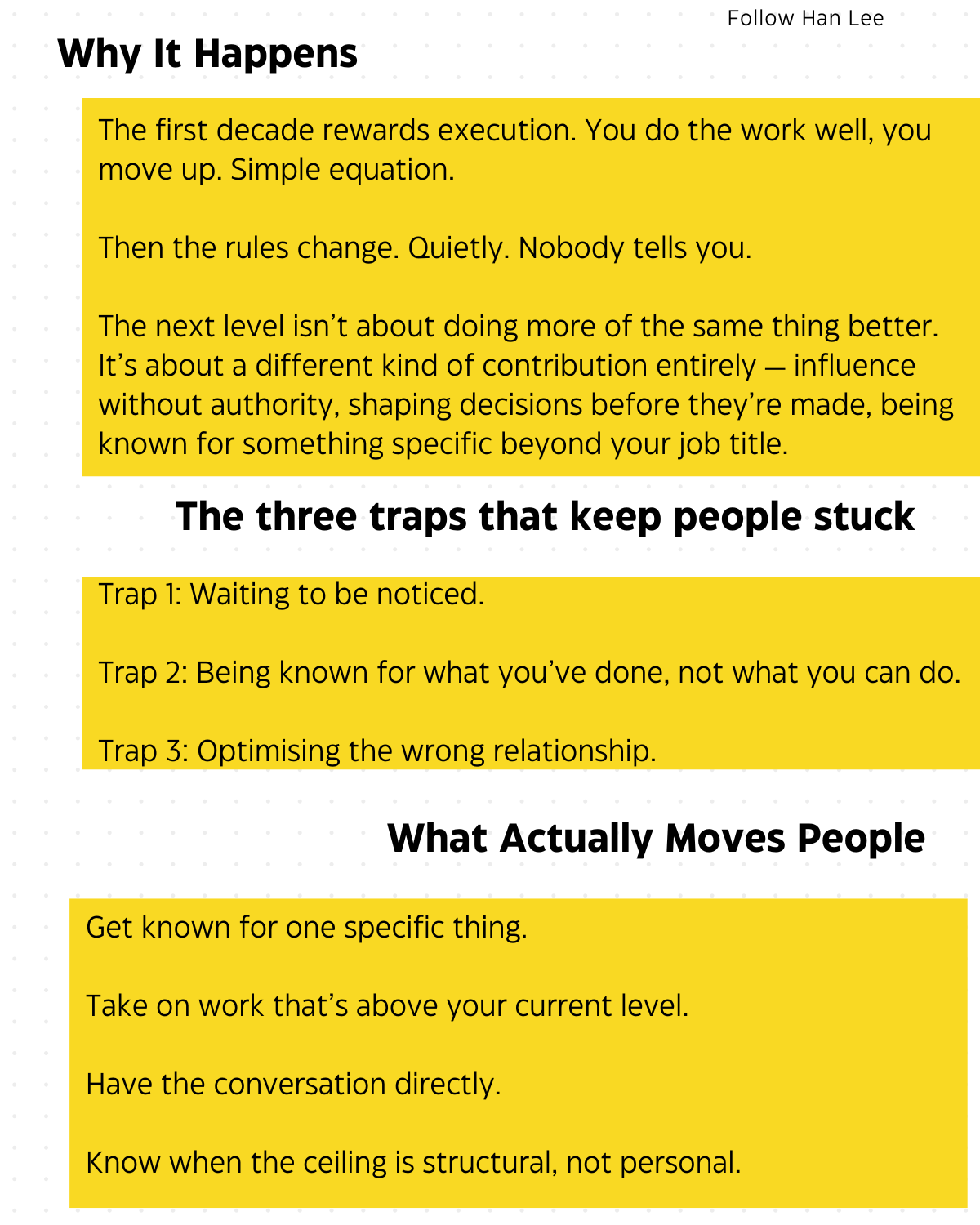
Why it happens
The first decade rewards execution. You do the work well, you move up. Simple equation.
Then the rules change. Quietly. Nobody tells you.
The next level isn't about doing more of the same thing better. It's about a different kind of contribution entirely — influence without authority, shaping decisions before they're made, being known for something specific beyond your job title.
Most people don't realise the game changed. They keep executing harder. And wonder why it's not working.
The three traps that keep people stuck
Trap 1: Waiting to be noticed.
The first decade taught you that good work gets recognised. The second decade doesn't work that way. Visibility is something you build, not something you earn quietly.
Trap 2: Being known for what you've done, not what you can do.
Your CV documents your past. Your reputation should sell your future. Most people stop investing in the second one once they have the first one looking strong.
Trap 3: Optimising the wrong relationship.
Your manager is one node in a network. If they're the only person who knows your work in detail, your career is one re-org away from a restart.
What actually moves people
Get known for one specific thing. Not five. One. A single domain, problem, or capability that, when someone in your industry has a question about it, your name comes up.
Take on work that's above your current level. Not extra tasks at your current level — work that simulates the next role. Volunteer for the cross-functional project, the messy stakeholder meeting, the under-resourced initiative. That's where you build the proof-points you need.
Have the conversation directly. "What would it take for me to be considered for X within twelve months?" Most people never ask. Most managers never volunteer the answer. The conversation costs nothing and unlocks a lot.
Know when the ceiling is structural, not personal. Some plateaus are about you. Many are about the org. Recognising the difference is half the battle — and sometimes the only honest answer is to leave.
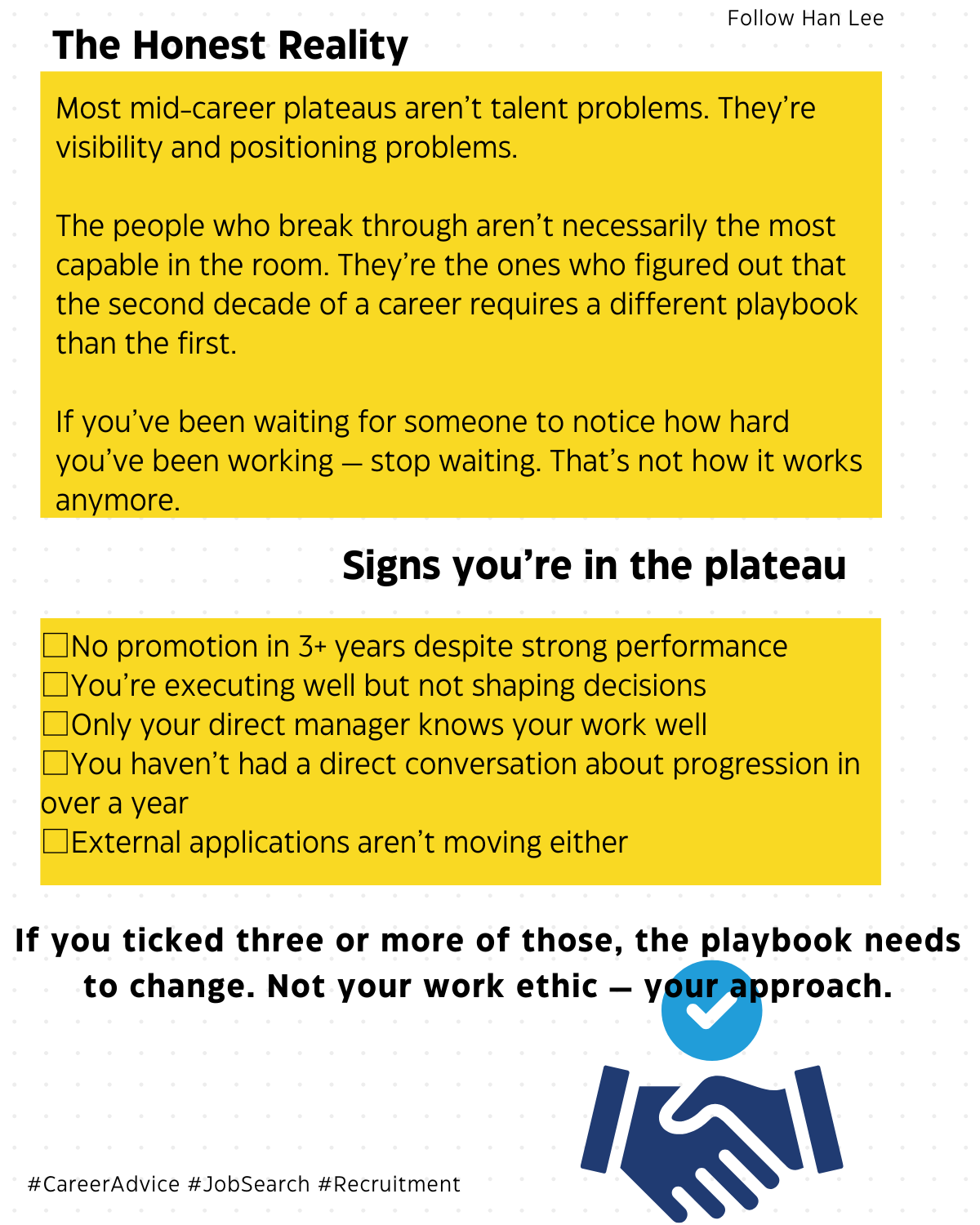
The honest reality
Most mid-career plateaus aren't talent problems. They're visibility and positioning problems.
The people who break through aren't necessarily the most capable in the room. They're the ones who figured out that the second decade of a career requires a different playbook than the first.
If you've been waiting for someone to notice how hard you've been working — stop waiting. That's not how it works anymore.
Signs you're in the plateau:
- No promotion in 3+ years despite strong performance
- You're executing well but not shaping decisions
- Only your direct manager knows your work well
- You haven't had a direct conversation about progression in over a year
- External applications aren't moving either
If you ticked three or more of those, the playbook needs to change. Not your work ethic — your approach.